Environmental Conditions for Refractory Materials in Glass Melting Furnace Regenerators
The quality of glass is generally unaffected by the refractory materials used in the regenerator area; however, the economic benefits of glass production are greatly influenced by the refractory materials chosen for the regenerator and the checker brickwork. Currently, it is common for other parts of the melting furnace to remain operational and require no maintenance, but forcing a furnace shutdown for repairs due to deterioration, blockage, or collapse of the regenerator system.
The following table shows the different environmental conditions for refractory materials and the typical practical applications of these materials in different locations, limited by these different conditions.
| Environmental conditions and typical practical applications of refractory materials for glass melting furnace regenerators | |||||||
| Location | Environmental Characteristics | Description | |||||
| High-Temperature Thermal Cycle | Low-Temperature Thermal Cycle | Solid Flying Material in Batch | Alkali in the Atmosphere | Condensed Alkali | Oxidation-Reduction | Typical applications/trends of refractory materials | |
| Lattice top | Moderate to severe | Slight to moderate | Moderate to severe | Moderate to severe | Slight to moderate | Moderate to intense | Typical refractories: 98% MgO, occasionally up to 90% MgO. Fir olivine bricks are not commonly used. Chromium-magnesium materials are generally not ideal. |
| Medium Part | Medium | Medium | Medium | Medium ~ Severe | Medium | Medium | Traditionally, typical refractory materials have been magnesia-olivine bricks. The general trend is not calcination with 90%~94% MgO or no calcination. |
| Lower part | Slight to moderate | moderate to severe | slight to moderate | moderate | moderate to severe | slight to moderate | Traditionally, typical refractory materials have been chrome bricks, with a trend towards MgO 50%-60% MgO-Cr. Magnesium is directly bonded, of medium quality, and calcined 40% MgO grade materials are also used. |
| “Hot” stove and “cold” stove | – | – | – | – | – | – | The situation is more difficult in the first, second, or third furnace. Some furnaces use ordinary clay materials and Al2O3. The material is placed in a “cold” furnace, but currently, most furnaces use alkaline materials. |
| The walls and arches of the regenerator | Only the brick side is subjected | Only the brick side is subjected | Low, except for fly debris retaining walls. | Moderate to severe | Moderate to severe | Strong to slight | Aside from alkali condensation, the severity generally decreases from top to bottom. The practical application of refractory materials varies considerably. Uncalcined and calcined chromium-magnesite, forsterite, mullite, and other materials are often used in multi-layered walls, with metal jackets and insulation layers in certain applications. |
The Type of Furnace Determines the Environmental Conditions
The environmental conditions for refractory materials vary greatly depending on the type of continuous melting furnace, which relates to the degree of reaction in specific zones within the furnace. Generally speaking, the erosion mechanisms of different types of refractory materials are not fundamentally different.
Regarding the design of cross-flame and horseshoe-flame furnaces, cross-flame furnaces appear to have a very high capacity for homogenizing foreign matter falling into the furnace pool from above the molten glass surface, and in most cases, they produce glass with fewer defects. On average, horseshoe-flame furnaces generally produce glass with more defects. This is partly due to the difficulty in obtaining a good temperature profile in many of these furnaces, i.e., the difficulty in establishing a thermal gradient between the hot spots in the molten pool and the low-temperature zones of the end walls. Another factor that often exacerbates the deterioration of refractory materials is the impact of the flame on the lattice/end-wall structure of the horseshoe-flame furnace. In many cases, this flame configuration makes it unsuitable for ordinary refractory materials and even creates a difficult environment for refractory materials with good resistance. A weakness of horseshoe-flame furnaces is that all fuel is fed through a small furnace at any given time. Therefore, the fuel input for a small furnace may be 2 to 3 times that of a transverse flame furnace.
Regarding the comparison between regenerative furnaces and direct-fired or heat-exchange furnaces: Direct-fired furnaces generally cause more severe erosion conditions on refractory materials. This is because achieving the planned production rate of such furnaces requires intensified combustion to compensate for insufficient preheating, and the temperature of the upper structure is excessively high for most refractory materials used. Another difficulty that sometimes arises is that these furnaces are usually quite shallow, encountering more turbulence at the furnace bottom, and experiencing more frequent changes in convection patterns. In these cases, erosion of the flow channels is often more severe, perhaps also related to the higher temperature of the molten glass passing through the flow channels.
At least in some colored glass furnaces, the question of whether to use an isolated refining section or a conventional lattice wall structure has long existed. The key reference point here is whether any alkali agglomeration has actually been observed in the refining section. If so, a completely isolated refining section structure may be preferable.
Electric melting furnaces and electrically assisted heating furnaces generally offer some advantages to the refractory environment, although localized high temperatures may occur at the electric heating bricks. In fully electric melting furnaces, the requirements for the refractory materials in the superstructure are lower, as the refractory material only plays a role during furnace firing. These furnaces operate under complete coverage of the batch during normal operation, allowing the superstructure refractory materials to be used indefinitely under these conditions.
Plate glass melting furnaces have less stringent refractory environmental conditions compared to most other furnaces. This is because plate glass melting furnaces utilize a large melting area, which serves as a means to achieve homogenization and produce glass approaching optical quality requirements. In terms of the refractory environment, these large furnaces are actually more advantageous.
Melting furnaces for fiberglass and other borosilicate glasses generally impose very harsh working conditions on the refractory materials. The first operational factor is the often high temperature, as many of these glasses are highly viscous. The second factor is the severe corrosive effect of borax. Borax volatilizes much faster than the alkalis used in soda-lime glass production (not originating from the glass contact area), resulting in significantly greater damage to the refractory materials. Simultaneously, in many such furnaces, these volatiles inevitably bypass the high-temperature zone and enter the refining section and various feed channels, causing further problems. During volatilization, silica enriches on the glass surface, potentially leading to crystallization, which further hinders thermal radiation penetration. Therefore, it is necessary to further increase the temperature of the superstructure to achieve thermal penetration.
The working conditions for refractory materials in lead glass melting furnaces are generally quite mild, except for the furnace bottom, where lead reduced from the glass often causes severe penetration problems into the furnace bottom refractory. The density of this lead glass also links these problems to the furnace bottom structure. When using a multi-layered furnace bottom structure, the upper layers of refractory tend to drift or even float in the molten glass. Therefore, the optimal furnace bottom structure for high-lead glass melting furnaces appears to be a monolithic furnace bottom constructed of a single refractory material.
In glass tank furnaces, parts not in contact with the molten glass, such as the upper structure (furnace roof, walls, burners, charging system), are damaged by high temperatures, dust erosion, and chemical corrosion from various volatiles. These volatiles originate from the molten glass, batch materials, and combustion products, and mainly consist of alkali metal oxides, borides, fluorides, chlorides, and sulfur compounds. These volatiles exist as alkaline vapors at high temperatures and condense into a liquid phase at lower temperatures. The upper part of the tank furnace and the heat exchange unit are constructed using refractory materials. Refractory materials are used for non-glass molten parts of the furnace.
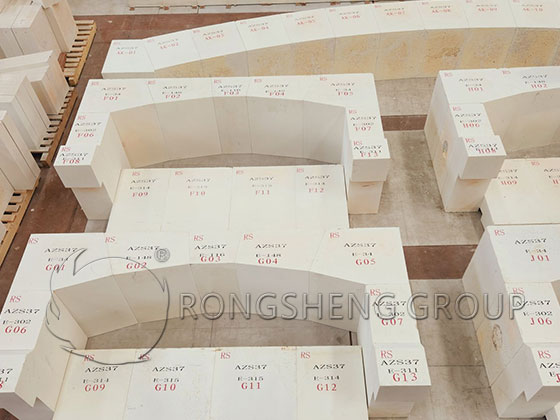
It should also be noted that glass melting furnaces are constructed from materials such as zirconia-corundum bricks (AZS fused bricks), zircon bricks, silica bricks, high-alumina bricks, clay bricks, and basic bricks. During furnace drying, the characteristics of various bricks, operating temperature, furnace size, and working characteristics must be comprehensively considered to rationally determine the drying curve. The selection of refractory materials for various parts of a horseshoe-flame soda-lime glass furnace is described. Soda-lime glass is used for bottles, jars, utensils, light bulbs, and fluorescent lamps. Insulation materials are also used in glass furnaces.