How to Improve the Slag Erosion Resistance of MgO-ZrO₂ Refractory Materials?
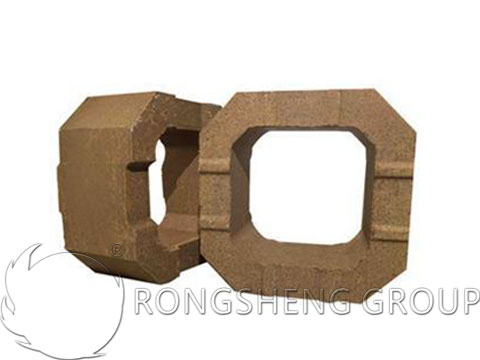
While pure magnesia refractories are widely used, they have some inherent weaknesses, such as a high coefficient of thermal expansion, poor thermal shock resistance, susceptibility to moisture absorption and hydration, easy penetration of molten slag into the brick, and poor resistance to thermal and structural spalling. Magnesia refractories composited with zircon (ZrSiO4) overcome these weaknesses. Introducing ZrO2 allows low-melting-point materials to form isolated islands, preventing the formation of a continuous liquid phase and improving the material’s resistance to penetration and erosion. With increasing zircon content, bulk density, compressive strength, load softening temperature, and thermal shock resistance initially increase and then decrease, while apparent porosity initially decreases and then increases. Performance reaches its maximum when zircon sand content is 20%, and optimal overall performance is achieved at a firing temperature of 1580℃. The resulting magnesia-zirconium bricks exhibit high load softening temperature and good erosion and thermal shock resistance, making them highly suitable for use as checker bricks in glass kiln regenerators.
How to improve the slag erosion resistance of MgO-ZrO₂ refractories?
With the increasing awareness of environmental protection, the use of MgO-Cr₂O₃ refractories is becoming increasingly restricted, and the promotion of chromium-free materials in the refractory industry has become an inevitable trend. Therefore, a relatively systematic study has been conducted on the preparation and performance of MgO-ZrO₂ refractories.
Through thermodynamic analysis and phase equilibrium diagrams, the reaction processes between the components in the MgO-ZrO₂ refractory material system were analyzed, clarifying the phase composition of the system under different conditions. Magnesium-zirconium clinker was synthesized using lightly calcined magnesia and zircon as raw materials. The microstructure and formation process of fused MgO-ZrO₂ clinker were studied, and the effects of the ratio of monoclinic ZrO₂ to desilicationized ZrO₂, the amount of fused Mg-zirconium clinker added, and the aggregate-to-matrix ratio on the performance of MgO-ZrO₂ refractories were investigated. The effects of Y₂O₃ addition amount and CaO addition method on the properties of MgO-ZrO₂ refractories were investigated, clarifying the preparation process and performance of MgO-ZrO₂ refractories. The slag erosion resistance of MgO-ZrO₂ refractories was examined using the rotary kiln slag resistance method, and its slag erosion resistance mechanism was explored. The main research results are as follows:
(1) In the MgO-ZrO₂ refractory system, when the CaO/SiO₂ ratio is less than 2, no CaZrO₃ is formed. The main phases are MgO, ZrO₂, and their solid solutions, with the bonding phases being forsterite, calcium magnesium olivine, magnesium rhodochrosite, and dicalcium silicate, etc. CaZrO₃ can only be formed in the refractory when the CaO/SiO₂ ratio is greater than 2.
(2) In the fused MgO-ZrO₂ clinker prepared from lightly calcined magnesia and zircon, SiO₂ mainly exists as 2MgOSiO₂ in the low-calcium region of the bonding phase. In the high-calcium region, it exists as a MgO-SiO₂-CaO glassy phase. During the electrofusion process, some MgO dissolved in ZrO₂ precipitates during cooling, forming magnesium-rich forsterite around its grains. Compared with MgO-Cr₂O₃ refractories, MgO-ZrO₂ refractories prepared using electrofused magnesia-zirconium clinker as the matrix have lower high-temperature flexural strength and poorer slag erosion resistance.
(3) When the ratio of monoclinic ZrO₂ to desilicationized ZrO₂ is 8:2 and the amount of electrofused magnesia-zirconium clinker added is 24%, the prepared MgO-ZrO₂ bricks have higher high-temperature flexural strength and better slag erosion resistance. The ratio of monoclinic ZrO₂ to desilicationized ZrO₂ is fixed. When the amount of electrofused magnesia-zirconium clinker added is changed, the number of cracks in the magnesia-zirconium bricks gradually increases with the increase in the amount of its addition. When its addition amount is 12%, MgO-ZrO₂ bricks exhibit good resistance to slag erosion and slag penetration.
(4) Changing the ratio of aggregate to matrix and increasing the aggregate content both increase the room temperature compressive strength and high temperature flexural strength of MgO-ZrO₂ bricks. However, the bricks contain more cracks, which adversely affect their resistance to slag erosion. The suitable aggregate-to-matrix ratio is 1.63.
(5) When the addition amount of Y₂O₃ is 1%, it can effectively reduce the apparent porosity and permeability of MgO-ZrO₂ bricks, and improve their bulk density, room temperature compressive strength, high temperature flexural strength, and slag erosion resistance. However, with further increases in the addition amount of Y₂O₃, cracks will form in the MgO-ZrO₂ bricks, reducing their performance.
(6) When free CaO is directly introduced as an additive using high-calcium magnesium calcium powder, although the bulk density and room temperature compressive strength of MgO-ZrO₂ bricks can be improved, their high temperature flexural strength decreases sharply. However, by using dicalcium fused magnesia instead of ordinary fused magnesia as raw material, and indirectly introducing CaO as an additive, not only can its bulk density and room temperature compressive strength be improved, but also its high temperature flexural strength, slag erosion resistance, and thermal shock resistance can be enhanced.
(7) MgO-ZrO₂ bricks prepared through optimized processes exhibit significantly better resistance to erosion by high-alkalinity slags than MgO-Cr₂O₃ bricks. Upon contact with the molten slag, a dense layer of high-melting-point compounds, such as dicalcium silicate (C₂S) and complex spinel (Mg(Al, Fe)₂O₄), first forms on the surface of the MgO-ZrO₂ brick. As the molten slag continues to penetrate the brick, the CaO in the slag reacts with the ZrO₂ in the MgO-ZrO₂ brick matrix, further forming a dense CaZrO₃ layer.
(8) MgO-ZrO₂ bricks show lower resistance to erosion by low-alkalinity slags than MgO-Cr₂O₃ bricks. Although a dense layer can form on the surface of MgO-ZrO₂ bricks under low-basicity slag conditions, its composition is mainly low-melting-point compounds of the MgO-CaO-SiO₂ system, which readily melt into the slag at high temperatures. Furthermore, due to the low basicity of the slag, a dense CaZrO₃ layer cannot form inside the magnesia-zirconium bricks.