The Relationship between AZS Refractory Materials and Glass Bubble Formation
From both chemical and physical perspectives, the relationship between AZS refractory material and glass bubble formation can be analyzed. The interior of cast AZS bricks contains numerous pores filled with gas. The composition of this gas is roughly the same as that of air, primarily nitrogen, oxygen, and a small amount of carbon dioxide. As the AZS bricks remain in contact with molten glass for an extended period, surface erosion exposes the internal pores, releasing the gas and forming bubbles.
Chemical Mechanism of AZS Refractory Material and Bubble Formation
Cast AZS refractories contain impurity elements that can be oxidized to form gases, such as carbon, sulfur, zirconium carbide, nitrides, and nitrogen oxides. When AZS refractory bricks are heated to above 1400℃, these impurity elements undergo oxidation reactions, forming corresponding gases such as nitrogen, carbon monoxide, carbon dioxide, and sulfur dioxide.
When the cast AZS bricks are cooled and then reheated, oxygen bubbles, or secondary bubbles, are generally generated at the contact point between the molten glass and the cast AZS bricks. This is because, under normal circumstances, cast AZS bricks contain a small amount (<0.3% (mass fraction)) of variable-valence elements, such as iron (Fe, Fe) or titanium (Ti, Ti). These variable-valence elements can change their valence state with temperature changes, thereby absorbing or releasing oxygen, as shown in the following reaction equation.

When the temperature decreases, reaction equation (1) proceeds in the forward direction, favoring the formation of Fe3+. When the temperature increases, reaction equation (1) proceeds in the reverse direction (reverse reaction), favoring the formation of O2.
Another reason for oxygen production is the electrochemical reaction (cell reaction) between the molten glass and the AZS refractory bricks, or a “remote” electrochemical reaction occurring without direct contact between the molten glass and the AZS refractory bricks. Alkali metal or alkaline earth metal ions are responsible for electron transfer. In this cell reaction, oxygen ions (O2-) in the molten glass are oxidized to oxygen (O2), i.e., the anodic reaction. High-valence iron (Fe3+) or titanium (Ti4+) in the refractory is reduced, i.e., the cathodic reaction. The reaction rate of this electrochemical reaction is directly proportional to the difference in the content of alkali metal or alkaline earth metal ions in the molten glass and the cast AZS refractory.
When the molten glass comes into contact with the cast AZS brick, the concentration of alkali metal or alkaline earth metal ions in the molten glass is much higher than that in the refractory material. Combined with the exudation of the glass phase, these metal ions, specifically Mn+, diffuse into the interior of the refractory material. As a result, they neutralize the electrons that diffuse into the AZS refractory material, maintaining its electroneutrality.
Oxidation Degree of Fused Cast AZS Refractory Materials
The quality of oxidation can be judged by its color. The oxidation degree of fused cast AZS refractories significantly affects the density, foaming tendency, and erosion resistance of refractory products, making it a crucial indicator of quality.
How to judge the oxidation degree by its appearance? There are three types of oxidation degrees: insufficient oxidation, just right oxidation, and excessive oxidation. High-quality fused cast AZS refractory bricks require the perfect oxidation degree, resulting in a light yellow color.
Insufficiently oxidized (reducing) products are gray and exhibit excessive foaming and glass phase exudation during use.
Just right oxidized products are light yellow and have strong erosion resistance.
Excessively oxidized products are white and have high porosity.
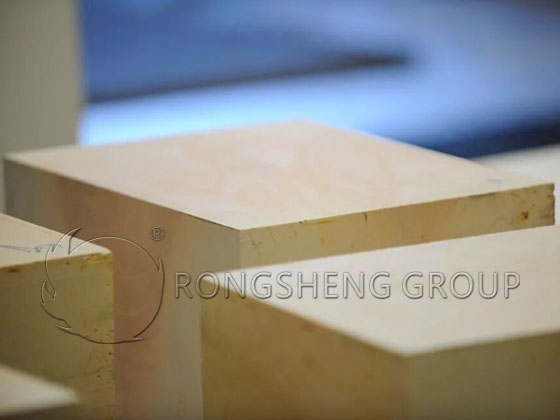
The color of refractory bricks is a reliable indicator of their oxidation state.
Refractory brick ions determine the “brick color.”
Fused AZS refractory bricks contain small amounts of impurities in their glass phase, mainly iron and titanium ions, at a concentration of tens of ppm. These ions determine the brick’s color and are a reliable indicator of its glass oxidation state.
If the product is optimally oxidized, only iron (III) ions will be found, resulting in a light red color; suboptimal oxidation will allow ferrous (II) ions or iron (O) to enter the glass phase, making the product gray.
In reducing products, some dissolved gases and residual carbon will be found in the material. These small amounts of reducing impurities affect two properties: exudation and foaming. The relationship between color and the degree of oxidation.