Selection of Material and Shape for Checker Bricks Used in Glass Kiln Regenerators
The grid structure is a crucial component of the regenerator for heat storage and transfer. It requires the grid bricks to be heat-resistant, corrosion-resistant, capable of storing a large amount of heat, transferring heat quickly, and having good resistance to rapid heating and cooling.
The heat storage efficiency of a regenerator is typically measured by the size of the grid’s heat-receiving surface area, i.e., the surface area of the grid capable of heat exchange. A larger heat storage area allows for the accumulation of more heat and the release of more heat, thus effectively increasing the preheating temperature of air and gas, which is more beneficial for fuel combustion.
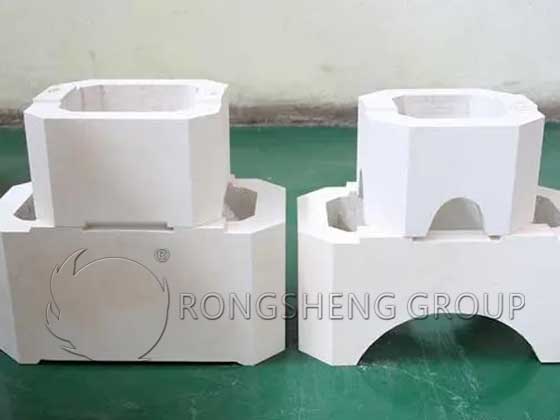
How to Select Checker Bricks for a Regenerator
Different alkaline-based checker bricks are used depending on the temperature and amount of fly debris in the top, upper, middle, and bottom sections of the regenerator.
The top section (above 1400℃) is characterized by high temperature and a large amount of fly debris, which easily forms a liquid phase with the bricks. This leads to fly debris adhesion and stress on the bricks. Therefore, zircon bricks or 98% high-purity magnesia bricks, which have excellent creep resistance at high temperatures, are used for the top section. Because the MgO in the high-purity magnesia bricks reacts with the ultrafine SiO2 powder from the fly debris entering the regenerator to form a low-temperature eutectic, zircon bricks are often used in the top checker sections (#1 and #3), where fly debris easily enters, while 98% high-purity magnesia bricks are often used in the end checker sections, which are less affected by fly debris.
The upper section (1000-1400℃) has less fly debris settling, so high-purity magnesia bricks can be used.
The central section (800-1000℃) has very little fly ash, but it is a sulfate agglomeration zone, making it prone to reacting with magnesia bricks to form magnesium silicate (MgSiO3). Simultaneously, SO2 and SO3 formed during the reaction of sodium sulfate in the feedstock and during fuel combustion also readily react with magnesium oxide:
MgO + SO2 → MgSO3 MgO + SO3 → MgSO4
The resulting magnesium sulfate or magnesium sulfite undergoes repeated solid-liquid transformation, causing volume expansion and leading to structural damage to the magnesia bricks. Therefore, direct-bonded magnesia-chrome bricks (DMC-12) with good thermal stability and low porosity are selected for this section. In areas with high environmental protection requirements, magnesia-chrome bricks are not permitted; periclase + forsterite bricks are commonly used instead.
The bottom (below 800℃) experiences alternating hot and cold temperatures, bears heavy loads, and is less susceptible to erosion by alkaline materials. Therefore, materials with good thermal stability and load-bearing strength are required, typically low-porosity clay bricks (DN-12, DN-13, or DN-15) or sillimanite bricks. Using a general approach without considering the properties of various alkaline bricks will result in damage to other parts of the lattice when one part is damaged, thus reducing the overall lifespan of the lattice. Since most alkaline refractory bricks, including magnesia-chrome bricks, are easily damaged in an atmosphere containing cracked hydrocarbons (reducing atmosphere), alkaline bricks can only be used in air regenerators and not in gas regenerators.
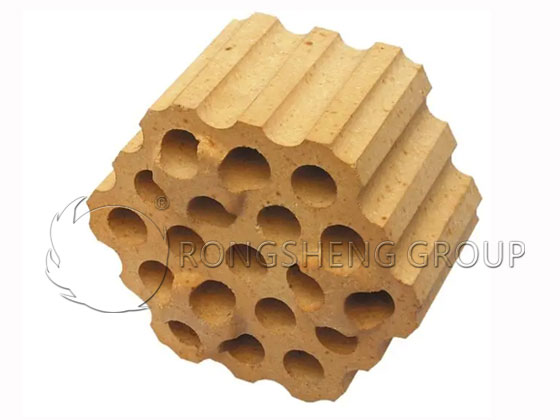
For regenerator lattice structures susceptible to fly erosion, the commonly used lattice brick configuration from bottom to top is as follows: low-porosity fireclay bricks or sillimanite bricks → directly bonded magnesia-chrome bricks, magnesia-zirconium bricks, or forsterite bricks containing 12% chromium → 96% high-purity fused magnesia bricks → 98% high-purity fused magnesia bricks → 24 layers of magnesia-zirconium bricks (VZ) or sintered zirconia-corundum bricks. To save investment, for the last 12 pairs of regenerator lattices where fly erosion is less severe, the top can be constructed without magnesia-zirconium bricks or sintered zirconia-corundum bricks, instead using 98% high-purity fused magnesia bricks directly stacked to the top.
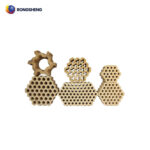
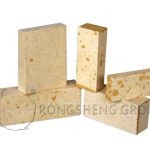
With the development of refractory materials, lattice bricks have evolved from strip bricks to cylindrical and cross-shaped bricks. The stacking method of the lattice has also evolved from the traditional basket-laying and grid-laying of strip bricks to the current direct stacking of cylindrical and cross-shaped bricks. The improved lattice bricks are not only easier to construct, but also have a more rational brick structure and higher stability in the bonding between bricks. This allows for a significant increase in the stacking height, resulting in stronger heat storage capacity. A comparison of strip bricks, cylindrical bricks, and cross-shaped bricks.