Erosion Analysis of Fused Zirconia-Corundum Bricks
The crystalline phases of fused zirconia-corundum bricks consist of zircon (ZrO₂), corundum (Al₂O₃), mullite (3Al₂O₃•2SiO₂), and zircon (ZiSiO₄). The main crystalline phases are ZrO₂ (32%–33%), Al₂O₃ (45%–48%), mullite (3Al₂O₃•2%) (0%–2%), a glassy phase (17%–20%), and a small amount of ZiSiO₄ from the raw materials. The surface of fused zirconia-corundum bricks cools rapidly, resulting in a higher proportion of the glassy phase. However, due to partial crystallization lag, some low-melting-point substances migrate and accumulate in the center, leading to an increase in the glassy phase. Besides the inhomogeneity of the glassy phase, variations also exist in its composition and thermal properties.
Erosion of Fused Zirconia-Corundum Bricks
The erosion of fused zirconia-corundum bricks is mainly divided into physical and chemical effects. Physical effects refer to the repeated exposure to rapid heating and cooling during long-term operation of the glass melting furnace wall, causing the surface layer to undergo a process of contraction and expansion. Excessive fatigue damages the structure of the fused zirconia-corundum bricks, leading to increased surface cracks and a loose structure. Therefore, under the influence of airflow, materials, and molten glass, it cracks and peels off, and this process repeats continuously.
Chemical effects on fused zirconia-corundum bricks are more complex and severe, and can be divided into four aspects:
(1) Precipitation of the Glass Phase
The fused zirconia-corundum bricks in the furnace wall are subjected to high-temperature molten glass (>1500℃) for a long time. On the one hand, the glass phase inside the brick gradually melts and precipitates (the minimum precipitation temperature is around 1150℃). On the other hand, alkaline molten glass containing Na₂O penetrates the brick along the pores and cracks, diffusing and interpenetrating with the precipitated glass phase. Therefore, the viscosity of the precipitated molten glass decreases and its fluidity increases, thereby intensifying the erosion and extending it deeper.
(2) Damage to the framework
As the erosion of the molten glass intensifies, the framework minerals constituting the brick are gradually infiltrated and surrounded by the Na₂O-containing molten glass, and the framework itself begins to be eroded. First, the dissolved mullite decomposes into α-Al₂O₃ and SiO₂, which in turn promotes the transformation of α-Al₂O₃ into β-Al₂O₃. As the temperature rises, all of β-Al₂O₃ dissolves in the molten glass, and the lattices of zircon and corundum are also damaged, leading to fragmentation, disintegration, and partial melting. β-Al₂O₃ gradually dissolves in the glass at high temperatures, with very little remaining. As the glass continues to diffuse and permeate, zircon microcrystals become free-floating; some are carried away with the molten glass, possibly becoming glass concretions, while others are retained. Although zircon can dissolve in glass, its solubility is very low. With temperature fluctuations, ZrO₂ rapidly crystallizes from the molten glass, forming skeletal or beaded zircon crystals.
(3) Crystallization of New Minerals
Since the framework minerals of the brick are partially melted in the molten glass, the composition of the original molten glass is altered. Therefore, when the ratio of SiO₂-Al₂O₃-Na₂O in the molten glass approaches the theoretical composition of nepheline, a large amount of nepheline crystals precipitate.
Al₂O₃ + 2SiO₂ + Na₂O → 2NaAlSiO₄ (nepheline)
(4) Nepheline Damage
Since the density of nepheline is less than that of the brick, the precipitation of nepheline crystals is accompanied by a significant volume expansion, making the brick structure porous. Although the melting of some crystalline phases in the brick increases the viscosity of the molten glass, providing some bonding and protection for the loose structure, it cannot completely block the effects of airflow, materials, molten glass, and gravity within the kiln. This leads to cracking and spalling into the molten glass, forming glass concretions. The spalled surfaces continue to be eroded and eroded by the molten glass, resulting in further spalling. Ultimately, this leads to the erosion and disintegration of the fused zirconia-corundum brick.
Extending the Service Life of Fused Zirconia-Corundum Bricks in Glass Furnaces
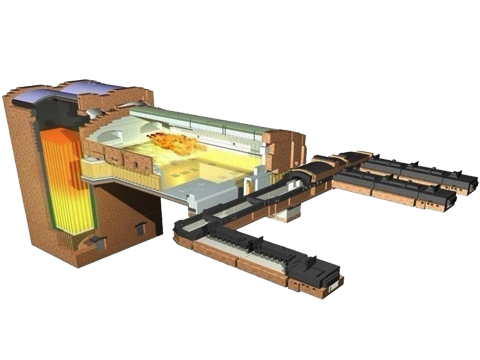
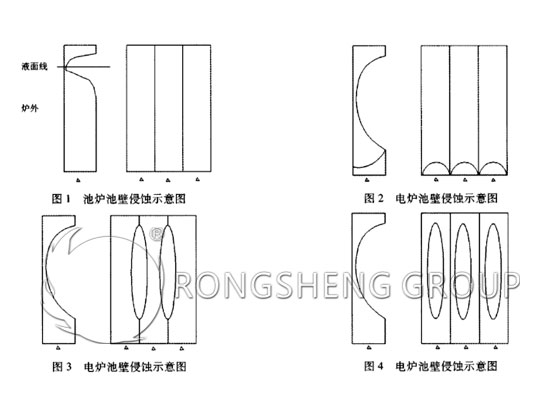
As is well known, glass furnaces involve horizontal melting, with the liquid surface moving horizontally. Except for flow holes, severe erosion occurs at the three-phase interface, as shown in Figure 1. Glass furnaces, however, involve vertical melting, mostly cold-top melting, where the glass surface is covered by a layer of raw material, resulting in fewer three-phase interfaces. Due to the vertical melting, erosion of the furnace wall bricks is no longer concentrated at the three-phase interface but rather occurs across the entire furnace. Therefore, the weak points of the fused alumina bricks become the entry points for erosion, as shown in Figures 2-4.
To address the erosion mechanism of fused zirconia-corundum bricks, it is crucial to strictly control the Na₂O content in the raw material composition. National standards require that the Na₂O content in 33#WS be below 1.45%, and in 41#WS below 1.3%. Our company’s furnace standard requires that the Na₂O content in 33WS be below 1.35%. The Na₂O content in 41#WS is below 1.05%.
For the erosion area shown in Figure 2, the riser-to-brick ratio must be 1.5:1. Pressure from the riser material effectively reduces residual porosity in the brick, enhancing the erosion resistance of the brick at the injection port, and ensuring no obvious shrinkage cavities remain at the injection port.
For the erosion area shown in Figure 3, the brick joints are strictly inspected during the assembly of the fused zirconia-corundum bricks, requiring them to be below 0.3mm. During kiln firing, the expansion differences between different parts are strictly controlled to ensure the tightness of the brick joints, thereby reducing gas ingress and preventing the formation of a three-phase interface at the joints, thus mitigating erosion in the area shown in Figure 3.
For the erosion area shown in Figure 4, the design requires the brick width to be less than 400mm. Excessive width leads to more residual shrinkage cavities and internal porosity. The riser-to-brick ratio must be 1.5:1. Pressure and gas venting rate improve the internal quality of the brick. Reduce insulation in the later stages of kiln operation to lower the brick temperature and reduce the erosion rate. After analyzing the erosion characteristics of fused zirconia-corundum bricks and the differences in erosion between fused zirconia furnaces and pool furnaces, corresponding measures can be taken to prevent and reduce erosion and extend furnace life. Selecting high-quality fused zirconia-corundum bricks can extend the service life of glass fused furnaces to a certain extent and enhance their market competitiveness. Therefore, in addition to improving the quality of fused zirconia-corundum brick raw materials, the main focus should be on reducing the glass phase content and increasing the riser ratio, thereby improving the service life of glass fused furnaces.
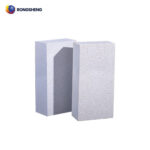
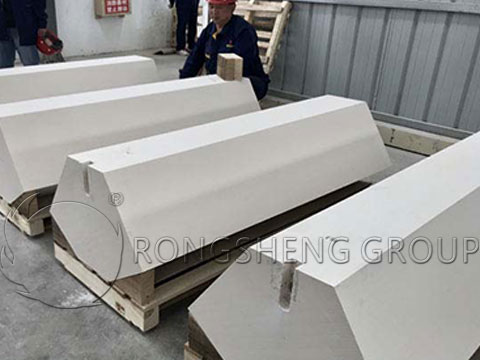
Rongsheng Refractory Factory provides high-quality fused corundum refractory brick, such as fused zirconia-corundum brick, AZS Bricks #33 #41, etc. Contact Rongsheng for a free quote now!