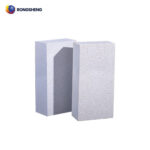
Wear-Resistant Castable for Vulnerable Parts of Cement Kilns
How should wear-resistant castables be selected for vulnerable parts such as cement kiln inlets and pulverized coal nozzles? Based on the operating conditions at cement kiln inlets and similar locations, the refractory materials used here should possess excellent high-temperature resistance, wear resistance, thermal shock resistance, corrosion resistance, and low thermal conductivity. Corundum is the only raw material with good high-temperature resistance; silicon carbide is the only raw material with good alkali corrosion resistance; both corundum and silicon carbide offer good wear resistance; silicon carbide and andalusite offer good thermal shock resistance; and andalusite and mullite offer low thermal conductivity. Therefore, abrasion resistant castables for the high-temperature zone of cement kilns should contain at least two minerals: corundum and silicon carbide, and one of mullite or andalusite. To obtain the required properties, high-temperature wear-resistant castables can contain four minerals simultaneously: corundum, silicon carbide, andalusite, and mullite. For Rongsheng abrasion-resistant castable manufacturers, contact Rongsheng for free samples and quotations.
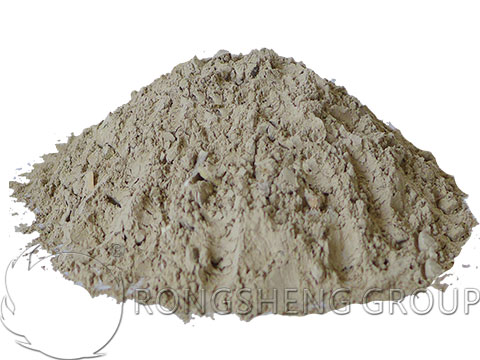
Raw Material Properties of Wear-Resistant Castables
Corundum is divided into sintered corundum and fused alumina. Fused alumina is obtained by melting alumina or bauxite in an electric furnace and then cooling it. Fused alumina has large grains, high density, few pores, and high hardness. Sintered corundum has small grains, many pores, and low hardness, but better thermal shock resistance. Generally speaking, corundum has excellent high-temperature resistance and wear resistance, but poor thermal shock resistance, relatively high thermal conductivity, and particularly poor resistance to alkali corrosion. Mullite also comes in sintered and fused types. Fused mullite has better performance. Generally speaking, mullite has good high-temperature volume stability, high hot strength, and strong creep resistance, with moderate to high thermal shock resistance and relatively low thermal conductivity. Andalusite is a member of the kyanite group of minerals. Kyanite minerals refer to three isomeric minerals with the molecular formula Al2O3-SiO2: kyanite, andalusite, and sillimanite. These three crystals share common characteristics: high refractoriness, high purity, and good erosion resistance. During calcination, they transform into mullite and substances with high silica content, accompanied by volume expansion (16%–18% for kyanite, 3%–5% for andalusite, and 7%–8% for sillimanite).
At 1300–1350℃, kyanite transforms into mullite and cristobalite, with a volume change of +18%. Due to the excessive expansion, the amount of kyanite incorporated is limited. The expansion from the kyanite transformation can be used to offset the shrinkage of monolithic refractories, and the resulting mullite can be used to improve the thermal shock resistance of castables. However, the cristobalite produced by the kyanite transformation is detrimental to thermal shock resistance.
At 1400℃, andalusite transforms into mullite and a high-silica glass phase, with a volume change of +4%. Due to the smaller expansion, it is beneficial to increase the amount of andalusite incorporated. The expansion resulting from the andalusite transformation can be used to counteract the shrinkage of monolithic refractories, and the resulting mullite can be used to improve the thermal shock resistance of castables. In contrast, the high-silica glass phase produced by the andalusite transformation has an extremely low coefficient of thermal expansion, which is highly beneficial for improving the thermal shock resistance of castables.
At 1500℃, sillimanite transforms into mullite, accompanied by an 8% volume change. Theoretically, the expansion resulting from the sillimanite transformation can counteract the shrinkage of monolithic refractories, and the resulting mullite also helps improve the thermal shock resistance of castables. Therefore, kyanite is commonly used as an additive in low- to mid-range monolithic refractories. Andalusite is commonly used as an additive in high- to mid-range monolithic refractories. The transformation temperature of sillimanite is too high, generally making it unsuitable as an expanding agent for monolithic refractories.
Silicon carbide possesses a high melting point, high hardness, high thermal conductivity, low expansion, and oxidizability. The high hardness of silicon carbide is utilized to improve the wear resistance of refractories. The low expansion and high thermal conductivity of silicon carbide are used to improve the thermal shock resistance of refractories. The potential for passivation oxidation or the formation of a SiO2 glaze layer by silicon carbide is used to improve the erosion resistance of refractories.
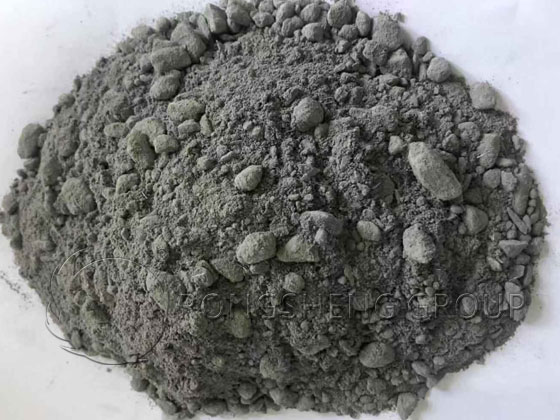
Refractories with anti-cracking and high wear resistance are used at the rotary kiln feed inlet
The refractory materials used at the feed inlet of a cement rotary kiln are among the most vulnerable parts of cement plant equipment. Damage to refractory materials is caused by various factors: wear from clinker and chemical reactions with the coating, deformation of the sheet metal due to kiln rotation, etc. Furthermore, cement plants play a vital role in a circular economy, with the widespread recycling of waste materials, leading to increasing damage from foreign components in these materials. Therefore, refractory materials must possess corrosion resistance and wear resistance; hence, high-strength castables and SiC-containing high-strength castables (hereinafter referred to as: SiC-containing castables) with high durability for coatings are used.
During regular maintenance at cement plants, the application of refractory materials at the feed inlet is usually a later step, requiring completion within a limited time before ignition. Because the kiln rotates while it is being constructed, precise time control is crucial. Additionally, the refractory material at the feed inlet is located close to the burner during ignition, so it must have sufficient anti-cracking properties. Meanwhile, the durability of refractory materials is also important for stable operation.
Wear-resistant abrasion resistant castables containing 10%-15% SiC can be used in cement rotary kiln feed inlets, as well as in feed inlets and gas quenching coolers.
Practical Applications of SiC Wear-Resistant Castables in Industrial Kilns
Practical application at the discharge port: After approximately one year of use following discharge port construction, this area was replaced simultaneously with the kiln lining. Production continued without maintenance after six months of use. After one year, some chipping was observed, but no detachment was observed. In practical applications in air quenching coolers, after approximately one and a half years of use following construction, the base material remained intact, demonstrating good durability, and it continues to be used today.
Rongsheng Refractory Materials, a manufacturer specializing in SiC-containing castables for cement plants, has demonstrated through its development, industrial kiln construction, and application in kiln linings that: at the kiln discharge port, clinker adhesion can be controlled; after six months of use, no repairs are required, and continued use is confirmed, with a confirmed service life of one year. Furthermore, in air quenching coolers, the service life exceeds one and a half years. From construction to operation, it has contributed to providing stable products.