China Zirconium Refractory Brick Rongsheng Refractory Brick Manufacturer
Introduction to Zirconium Oxide Raw Materials. There are two types of zirconium-bearing ores in nature: zircon and zircon. Zirconium oxide is extracted from these ores. Within different temperature ranges, zirconium oxide has three crystal forms: monoclinic, tetragonal, and cubic. It exhibits different crystal structures at different temperatures: from room temperature to 1770℃, it has a monoclinic structure with a density of 5.68 g/cm³; from 1170-2370℃, it has a tetragonal structure with a density of 6.10 g/cm³; and from 2370-2706℃, it has a cubic structure with a density of 6.27 g/cm³. The higher the temperature, the greater the density.
Excellent Properties of Zirconia Raw Materials
Zirconium oxide possesses many excellent properties, such as a high melting point of 2700℃ and good chemical temperature characteristics. It is resistant to both acids and alkalis, and exhibits high-temperature strength, with a load of 200 kPa at 2000℃. However, due to its reversible polycrystalline transformation, it has low thermal conductivity and a high coefficient of linear expansion, resulting in poor thermal shock resistance in zirconia products. This makes them prone to cracking during production and use. Therefore, stabilized and partially stabilized zirconia are often used in manufacturing processes to overcome this thermal shock problem. Common thermal shock modifiers include CaO, MgO, Y₂O₃, and Ce₂O₃. The following three types of zirconia bricks primarily use zirconia as their raw material, with a high zirconium content, and are mainly used in ultra-high temperature kilns and key components of some high-temperature kilns. China zirconium refractory brick.
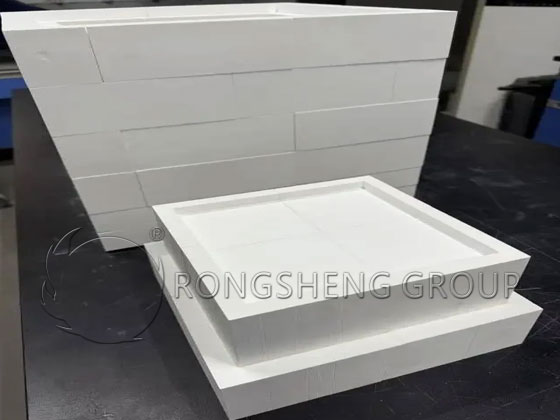
Rongsheng Zirconia Brick Manufacturer
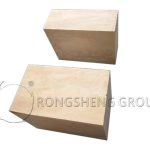
Zirconium oxide bricks are classified into fused cast high-zirconia bricks and sintered high-zirconia bricks based on their production process.
Electrofused High-Zirconium Bricks
Fused cast high-zirconia bricks are made by melting high-purity zirconia raw materials at high temperatures and then casting them. Fused cast high-zirconia bricks are mainly composed of zircon, thus possessing extremely high erosion resistance, low foaming and precipitation rates, and no pollution to glass furnaces. However, they are relatively expensive. They are mainly used in LCD substrate glass furnaces, borosilicate glass furnaces, cover glass furnaces, and fiberglass furnaces. Fused cast high-zirconia bricks mainly come in two grades: RS-Z95 and RS-Z89.
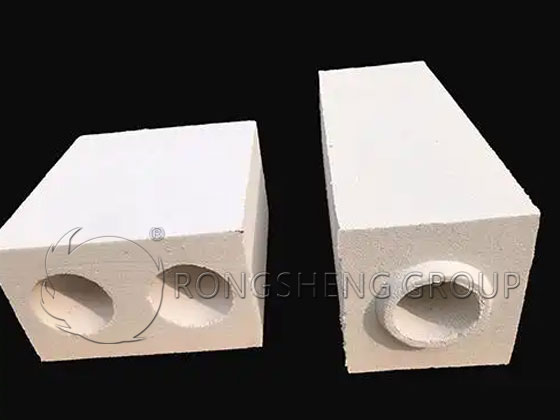
Zirconium Hollow Sphere Bricks
Zirconium hollow sphere products are ultra-high temperature, energy-saving, lightweight, heat-insulating refractory materials in the zirconia system. They not only possess the same high-temperature resistance as zirconia products but also have the advantages of low bulk density and excellent thermal insulation performance. With a thermal conductivity of 0.3-0.4 W/m·K, only half that of ordinary zirconia products, it is a special refractory material that can be stably used up to 2400 ℃ under oxidizing, reducing, and vacuum atmospheres. Zirconia hollow spheres are the best furnace lining refractory materials for various ultra-high temperature kilns, tungsten and molybdenum metal processing, artificial crystal production, and quartz industrial production.
Zirconium Heavy Bricks
Zirconium heavy bricks are mainly used in ultra-high temperature kilns such as tungsten and molybdenum processing furnaces, carbon black furnaces, crystal growth furnaces, and fused silica furnaces.
Performance of Zirconia Bricks
- Superior Wear Resistance
- Higher Surface Smoothness
- Fineer Texture
- Higher Hardness
Rongsheng zirconia bricks outperform other materials in chemical corrosion resistance and wear resistance. China zirconium refractory brick. Therefore, they are widely used in harsh conditions where it is difficult to use metals or other materials. Their excellent wear resistance is highly praised by customers and is one of the most wear-resistant materials on the market.
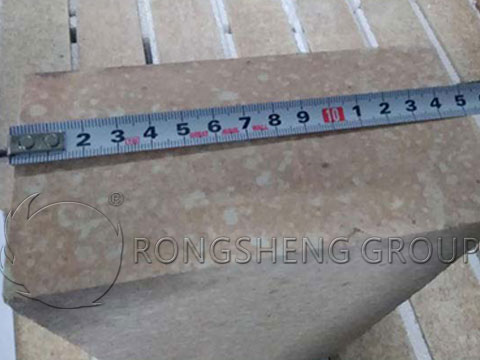
Theoretically, the wear resistance of zirconia bricks is 15 times that of alumina ceramics, and the coefficient of friction is only half that of alumina ceramics, which already has a very low coefficient of friction. In terms of density, zirconium oxide bricks have a density of 6, resulting in a finer texture. Furthermore, zirconia bricks have a higher surface smoothness, resembling a mirror finish, resulting in a lower coefficient of friction. The Mohs hardness of zirconia bricks can reach over 9.
Applications of Zirconia Bricks
Zirconium bricks have outstanding advantages in chemical corrosion resistance and wear resistance. China zirconium refractory brick. Therefore, they are widely used in harsh conditions where it is difficult to use metals or other materials. Examples of applications include semiconductor equipment components, mechanical seals, papermaking machinery, fiber machinery, electronic components, cutting tool rolls, sleeves, watch cases, decorative items, other components requiring chemical and heat resistance, and ceramic parts for mechanical structures.
Zirconium oxide bricks have a high surface finish, resembling a mirror, and are extremely smooth, reducing wear and tear, further extending equipment lifespan, and minimizing material contamination. Furthermore, zirconia bricks possess high toughness, overcoming the inherent brittleness of ceramics, resulting in superior impact resistance.